Adonelle Touch and Self-Determination Theory: A Meaningful Connection
Professor Richard M. Ryan, co-creator of Self-Determination Theory, recognised a meaningful resonance between the four pillars of Adonelle Touch and the psychological needs central to human motivation and wellbeing.

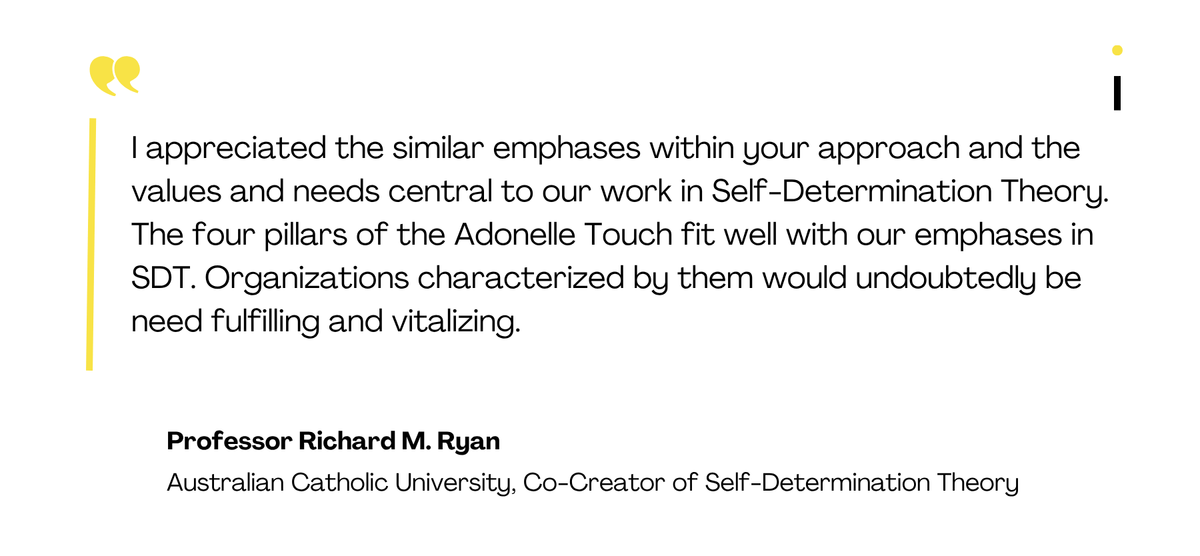
One of the most meaningful responses I have received to Adonelle Touch came recently from Professor Richard M. Ryan, Co-Creator of Self-Determination Theory.
“I appreciated the similar emphases within your approach and the values and needs central to our work in Self-Determination Theory. The four pillars of the Adonelle Touch fit well with our emphases in SDT. Organizations characterized by them would undoubtedly be need fulfilling and vitalizing.”
That matters because Self-Determination Theory is not a marginal reference point. It is one of the most influential theories of human motivation, wellbeing, and flourishing, built around the conditions that help people feel autonomous, connected, capable, and alive.
So when Professor Ryan recognised a resonance between Adonelle Touch and the needs central to Self-Determination Theory, it really was an important moment.
Adonelle Touch was not written as a psychology book. It grew from business experience, sex-positive values, lived practice, and the question behind the framework:
What if the same values that make relationships healthy could also help organisations thrive?
In developing the framework, those relationship values were expressed through four pillars: Inclusivity, Consent, Openness, and Empowerment.
In his note, Professor Ryan recognised that these pillars fit well with the needs and values central to Self-Determination Theory. More specifically, he connected empowerment with autonomy support, openness and inclusivity with relatedness support, and consent with elements of both autonomy and relatedness.
For me, this was not only encouraging. It was a meaningful recognition of the direction the framework is opening and a signal that Adonelle Touch belongs in serious conversations about leadership, branding, organisational life, human motivation, and wellbeing.
The Adonelle Touch pillars are not only “nice values.” They point toward conditions people need in order to feel more alive, engaged, connected, and able to contribute.
This matters for organisations.
A workplace, brand, or culture that supports autonomy and relatedness is likely to feel different from one built mainly on control, pressure, image, or performance theatre. People may still work hard. Customers may still make decisions. Teams may still pursue ambitious goals. But the quality of the relationship changes.
When people feel included, they can belong more fully.
When people feel invited rather than pushed, they can choose with more trust.
When communication is open, honest, and human, people can relate with less defence.
When people feel empowered, they can contribute with more agency.
That is the bridge I hoped Adonelle Touch could begin to build: between the ethics of positive sexuality and the practical realities of leadership, branding, culture, and organisational life.
Professor Ryan’s response does not make Adonelle Touch a formal extension of Self-Determination Theory. But it does show a meaningful resonance with established thinking about human motivation and wellbeing. More importantly, he recognised that organisations characterised by the Adonelle Touch pillars would be “need fulfilling and vitalizing” – a powerful confirmation that these values are not only ethically appealing, but deeply connected to the conditions in which people can feel more alive, engaged, and able to contribute.
That resonance matters.
It suggests that the framework is not only culturally interesting or personally meaningful. It connects with deeper questions about what people need in order to trust, engage, and flourish.
For a framework bringing sex-positive values into organisational life, that is an important moment.
It opens a door to further dialogue, research, and application.
And it strengthens one of the core ideas behind Adonelle Touch:
Healthy organisations are not built only through strategy, performance, or communication. They are built by creating conditions where people can feel respected, connected, autonomous, and alive.
That is where trust begins.
Professor Richard M. Ryan is a clinical psychologist and co-creator of Self-Determination Theory, one of the leading theories of human motivation. His work on autonomy, relatedness, motivation, vitality, and wellbeing has shaped psychology, education, work, sport, health, and organisational research internationally. He is widely recognised as one of the most influential and highly cited researchers in psychology and social sciences.
In Stanford/Elsevier-based Top 2% Scientists data, Ryan is listed among the highest-ranked researchers globally, including a 2025 overall rank of 11 and a rank of 3 in Social Psychology.